The research project ELO turns drones into smart helpers at sea. Supported by AI, they provide emergency responders with a real-time situational picture during maritime accidents – but only once they become even more autonomous can they unlock their full potential.
Germany’s coasts are more than holiday destinations: this is where wind farms, pipelines and busy shipping lanes meet – a hub of critical infrastructure. Yet these very areas are also vulnerable. The need for protection is growing, covering accidents, maritime emergencies and environmental hazards as well as defending against targeted sabotage. In every case, one thing matters most: fast detection and response. But by the time reconnaissance aircraft are airborne and delivering reliable information to the command center, valuable time may already have been lost. This is exactly where the research project ELO – Echtzeitlagebild Offshore comes in.
The aim is to develop an intelligent system that reaches maritime emergencies as quickly as possible, monitors them in real time and improves the coordination of emergency responders during incidents. Drones play a central role: they collect live data and transmit it in real time to the responsible emergency services. The result is a rapid situational picture that supports responders in their decisions and strengthens maritime safety.

ELO’s key questions
To achieve this goal, the project addresses several central questions:
How can offshore drone missions be planned and carried out with fast response times?
How can large volumes of live data from maritime incidents be processed and transmitted reliably and in real time?
How can this information be integrated into the existing data systems of emergency services?
How can drones be automatically inspected, maintained and prepared for the next mission after deployment?
The untapped potential of drones
Drone missions are significantly more cost-effective than helicopter or aircraft deployments. Drones can be used flexibly and launched much faster. So far, however, their potential has only been partially realized: although the drone flies to its mission area on its own, the manual preparation it requires means that pilot and drone usually remain at the same launch site – so its full mobility goes unused. In addition, after a fully remote-controlled mission, the drone has to be prepared again for its next flight.
Autonomous maintenance
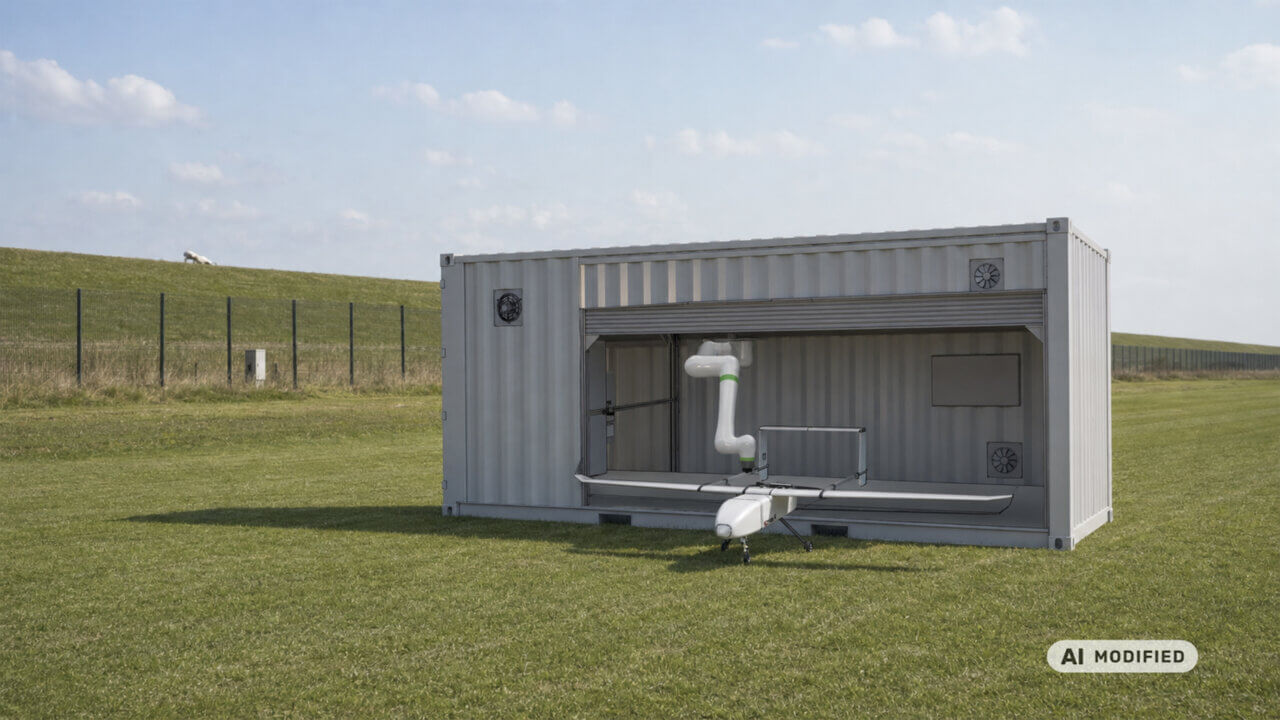
This is where the drone team at ZAL GmbH comes in. Existing drone-in-a-box systems already enable autonomous takeoffs and landings, but they lack automated maintenance functions. The ZAL team is therefore developing an integrated system: after landing, the drone moves on its own to the maintenance container, a robotic arm docks onto it and charges it, cameras check its condition using AI-based image recognition, a cleaning system removes salt deposits, for example – and once maintenance is complete, the drone is immediately ready for its next mission.
The final process is planned to look like this:
- The drone is automatically undocked from its storage container.
It flies its mission and automatically transmits the data to the command center.
After landing, it automatically docks into the maintenance container.
There it is inspected, cleaned and recharged or refueled.
The drone is ready for its next mission.
For this part of the project, ZAL is building a demonstrator. The video shows how automatic docking and undocking work – just as they will later in the maintenance container.
Interested in automated drone systems or have questions about the ELO project? Share your thoughts with us and give us a call:

Project partners
ZAL GmbH
Fraunhofer IFAM
Light DS GmbH
Hanseatic Aviation Solutions GmbH
Central Command for Maritime Emergencies Germany (Havariekommando, associated partner)
Naval Air Wing 3 (Marinefliegergeschwader 3, associated partner)

Photos:
Header image: Operation of an ORKA UAS from the deck of a multi-purpose vessel (Fraunhofer IFAM, Tim Strohbach)
Image 1: Aerial view of a UAS during an exercise by the Central Command for Maritime Emergencies with a multi-purpose vessel (CiS GmbH)
Image 2: Visualization of the automated maintenance system (ZAL GmbH)